

The EU's 46 new strategic projects: why 19 are recycling
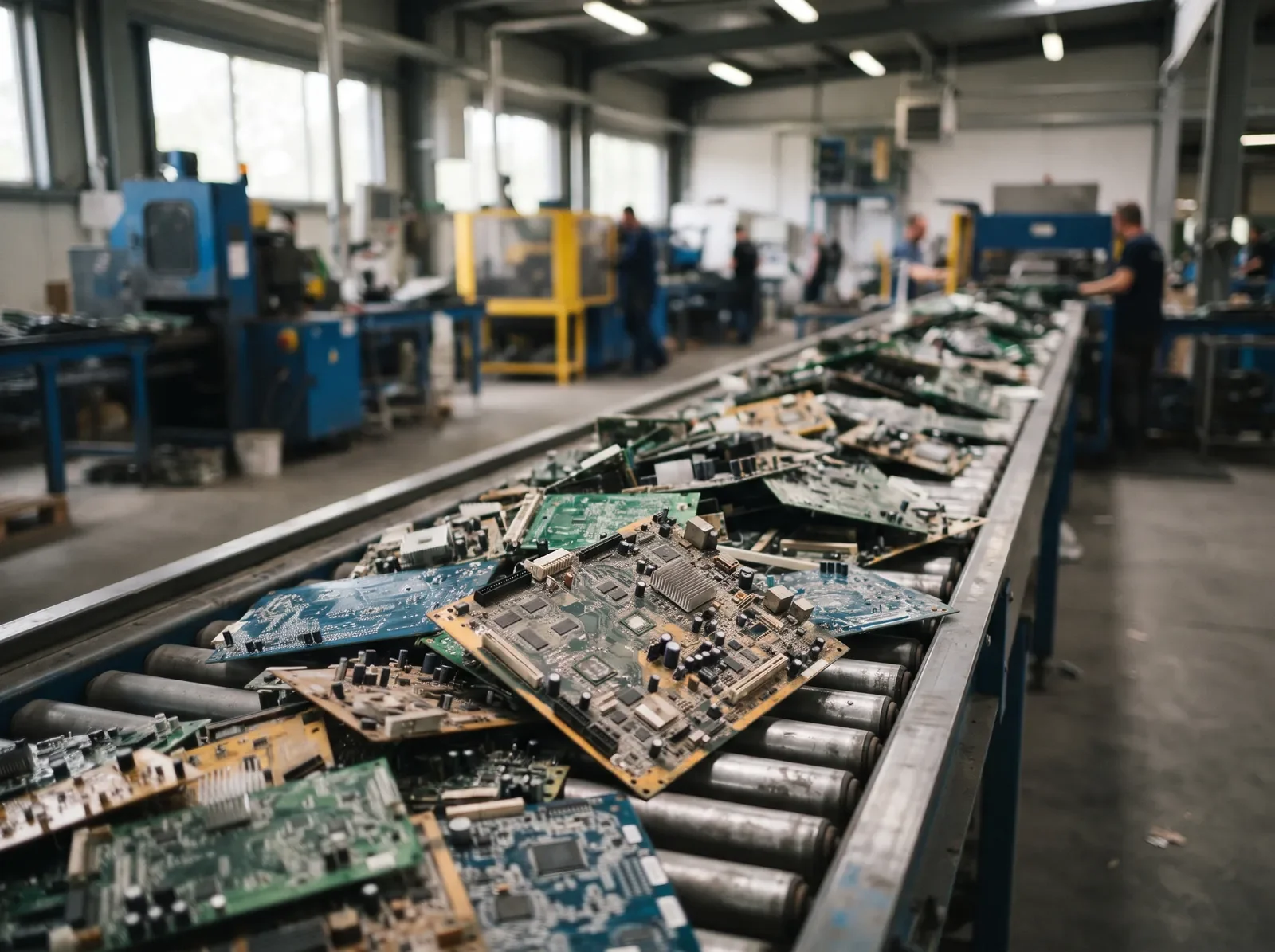
Urban mining recovers copper, gold and silver from discarded electronics such as these circuit boards. On 9 October 2026 the European Commission named 46 Strategic Projects under the Critical Raw Materials Act; 19 are recycling projects. Illustrative image.
On 9 October 2026 the European Commission named 46 new Strategic Projects under the Critical Raw Materials Act, chosen from 102 applications. Nineteen are standalone recycling projects and five more combine processing with recycling, so 24 of the 46 have a recycling element. It signals that Europe now counts urban mining, the recovery of metals from products already in use, as part of its critical mineral supply.
The 46 projects at a glance
The projects sit in 16 EU member states and cover 15 of the 17 strategic raw materials. Here is how they split by stage.
| Stage | Projects |
|---|---|
| Extraction | 8 |
| Processing | 11 |
| Recycling | 19 |
| Integrated: extraction and processing | 3 |
| Integrated: processing and recycling | 5 |
| Total | 46 |
Source: European Commission press release IP/26/2113, 9 October 2026. Highlighted rows include recycling (24 of 46).What is an EU Strategic Project?
A Strategic Project is a project the European Commission recognises under the Critical Raw Materials Act (CRMA) as contributing to the EU's supply of strategic raw materials. Status gives help with financing and faster permitting. Permit timelines are 27 months for extraction and 15 months for processing and recycling.
The Act has been in force since 23 May 2024. It sets four benchmarks for 2030: at least 10% of annual EU consumption from extraction, 40% from processing and 25% from recycling, with no more than 65% from any single third country.
Why does it matter that 19 are recycling?
Recycling is a benchmark where the gap is large. The European Court of Auditors warned in February 2026 that the Act's 25% recycling target for strategic raw materials is still far away, as Clean Energy Wire reported.
The Commission says the 46 new projects, together with the 47 EU projects chosen in March 2025 and the 13 outside the EU chosen in June 2025, could fully meet the 2030 recycling benchmarks for lithium, cobalt and rare earth elements. That is a projection of what the projects could deliver, not a result.
Permitting is only one part of a project's timeline, so these two numbers are not like for like. S&P Global puts the average time for a new copper mine to go from discovery to production at 17 years, while a recycling project's permit is limited to 15 months.
Where does urban mining fit?
Urban mining is the recovery of metals from products that have already been made and used, such as electronics, catalytic converters and solar panels at the end of their life, rather than from newly mined ore. Electronics are the best-measured of these waste streams, and they are large and under-collected. The UN's Global E-waste Monitor 2024 estimated that 62 million tonnes of end-of-life electronics were generated worldwide in 2022, with 22.3% documented as properly collected and recycled, and projected 82 million tonnes by 2030. In the EU, the electronics collection rate was 40.6% in 2022 against a 65% target, according to the European Environment Agency.
Circuit boards contain copper and precious metals such as gold and silver, one characterisation study found. Every tonne that is collected and handled properly is a tonne of supply that does not have to come from a new mine.
What the announcement does not say
The Commission gives project counts by stage and by material for the 46 projects as a whole. It does not say which materials the 19 recycling projects target. The material counts, such as 12 projects involving nickel and 10 involving cobalt, cover every stage, so they cannot be read as recycling counts. Project-level detail is the place to check for specifics; the Commission's release is the starting point.
What it means for the UK
The UK is outside the EU scheme, so none of the 46 is a UK project. Vision 2035, the UK Critical Minerals Strategy published in November 2025, sets its own goals for 2035: meeting at least 10% of annual demand for critical minerals, in aggregate, through domestic production (including at least 50,000 tonnes of lithium) and 20% through recycling, with no more than 60% of aggregate annual demand supplied by any one country.
Majestic Corporation plc is a UK urban miner. At its 50,000 sq ft facility in Wrexham, Wales, it handles waste streams that include electronics, catalytic converters, end-of-life solar panels and battery materials, and sends material to smelter and refinery partners to recover precious and base metals, with gold, silver and palladium primarily recovered from circuit boards (company results, 29 June 2026). Majestic is not part of the EU programme. The point is the direction: on both sides of the Channel, recovering metals from electronics is becoming part of how governments plan critical mineral supply.
What to watch next
A new call for Strategic Project applications, which the Commission says it will announce soon, towards the end of 2026.
The Commission's Circular Economy Act proposal, including a revision of the WEEE Directive, which EUWID reported on 20 October 2026 is now planned for 18 November 2026, a week later than previously reported.
Frequently asked questions
What are the EU's new Strategic Projects? They are 46 projects the Commission selected on 9 October 2026 under the Critical Raw Materials Act to strengthen EU supply of strategic raw materials. They span extraction, processing and recycling across 16 member states.
How many of the 46 are recycling projects? Nineteen are standalone recycling projects. Five more combine processing and recycling, so 24 have a recycling element.
What is urban mining? Urban mining is recovering metals from products and waste streams already in use or at end of life, such as electronics, rather than from newly mined ore.
Does Strategic Project status mean EU funding? Status brings help with financing and faster permitting. The Commission's announcement reports more than €2 billion of support mobilised since December 2025 separately, and does not say that status itself carries funding.
Are any UK projects included? No. The 46 projects are in 16 EU member states. The UK has its own Critical Minerals Strategy.
When is the next call? The Commission says it will announce a new call soon, towards the end of 2026.